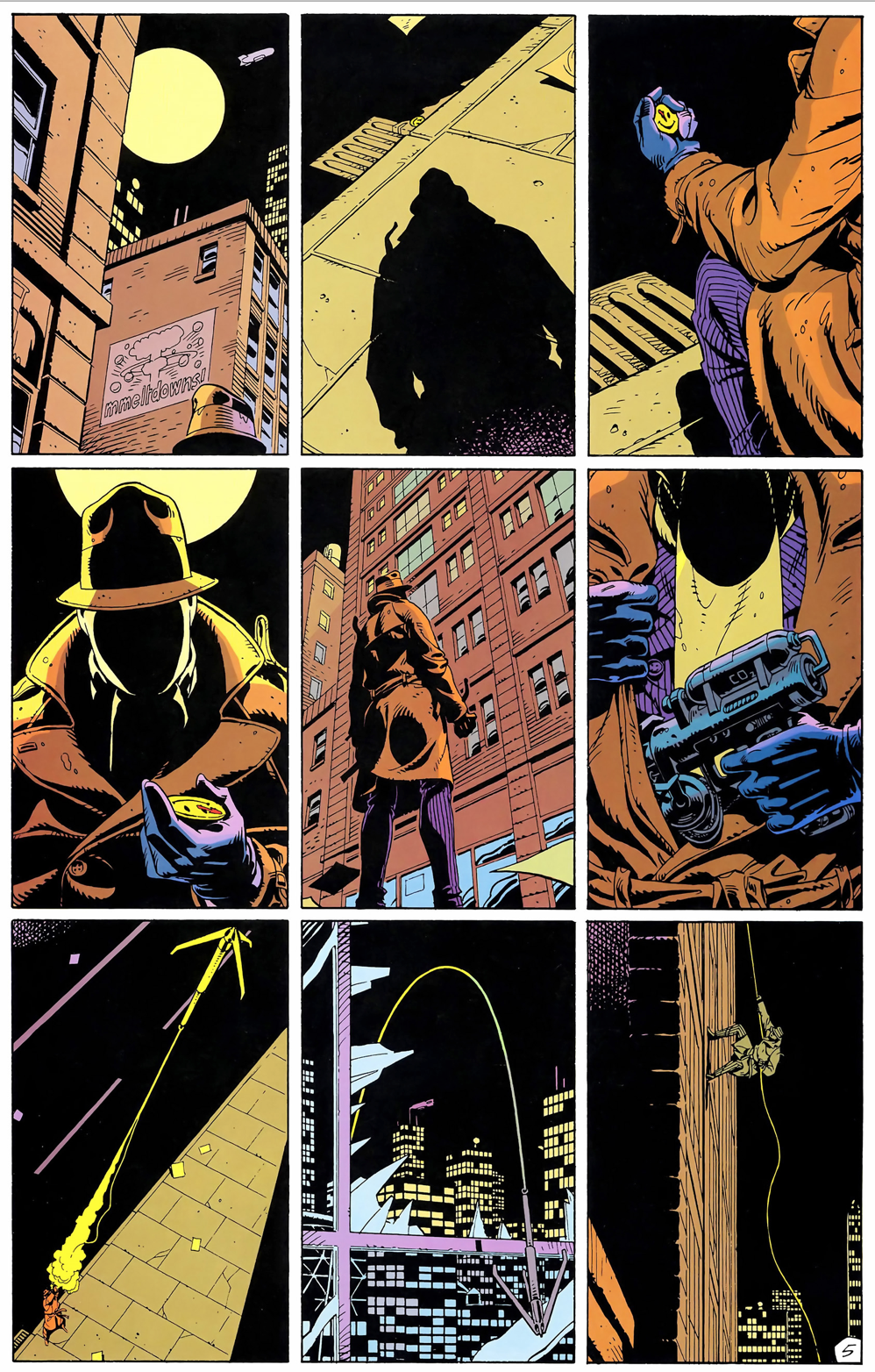
That enormous spike in issue six (“The Abyss Gazes Also”) immediately leaps out at us. This is the chapter in which Dr. Malcolm Long examines Rorshach and we learn the back story of the book’s protagonist. Indeed, the preceding chapter (“Fearful Symmetry”, the most formally inventive chapter in the book) is also primarily, though not exclusively, about Rorschach. The seventh chapter (“A Brother to Dragons”, which is the first to have pages with more than nine panels (during the sex scenes)) primarily focusses on Dan and Laurie. Certainly, then, an interpretation that suggests a connection between the non-powered heroes of the book and the nine-panel grid becomes an enticing route for thematic investigation. This would be supported by the fact that the alien-infected final chapter has the lowest number of nine-panel grids (only four out of the thirty-two pages), and is the only chapter that uses traditional single panel splash pages.
Watchmen provides a very obvious example of how a study like this might work because it is so formally structured. What we are not particularly interested in, however, is analyzing individual works like Watchmen but charting the evolution of the comic book format over time. We are interested in the typical comic books of various periods, not the ones that have been proclaimed the best. Indeed, it is more likely than not that Watchmen would not even be randomly selected into our sample set! Examining changes to comics over time is one of the things we are most interested in.
Take, for example, Saga. I taught my students this book shortly after teaching Watchmen. One of the things that my students immediately noted is that the first issue contains six splash pages, and that the splash in general is one of the visual hallmarks of the work. Moreover, they noted how much more quickly it reads than does Watchmen because the volume of text is quite reduced. I think it is a commonplace to note that contemporary superhero comics contain less text than do comics from thirty years ago, and that those contain less text than comics from thirty years prior to that. Yet we lack the tools to actually demonstrate this assumption that is so routinely taken for granted.